A
B C D
E F G
H I J
K L M
N O P
Q R S T
U V W
X Y Z
A
Air Conditioner - Assembly of equipment for the simultaneous
control of air temperature and relative humidity.
Accumulator: Tank on the suction side of a system
that holds excess refrigerant to prevent slugging the compressor
with liquid.
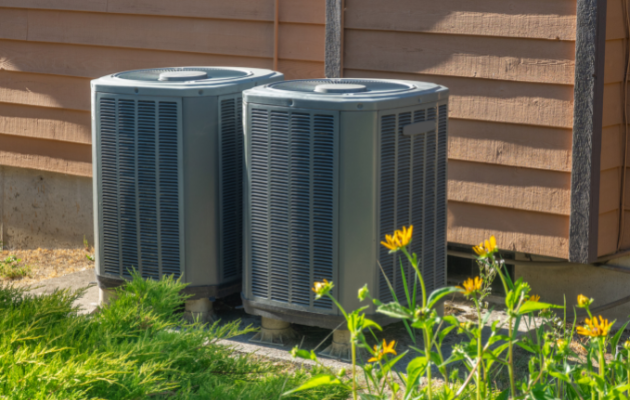
Air Cooled - Uses a fan to discharge heat from the
condenser coil to the outdoors.
Air-cooled system A type of air conditioning system that
uses freon as a refrigerant and air as a condensing medium.
Typically, the air-cooled condenser is located outside and
refrigerant lines are piped to it from the indoor unit.
AFUE (Annual Fuel Utilization
Efficiency) - A rating that denotes the efficiency of gas heating equipment. It is
the amount of heating your equipment delivers for every
dollar spent on fuel. A higher rating indicates more efficient
equipment. This rating is calculated in accordance with
the Department of Energy test procedures.
Ambient Temperature - The temperature, usually of the air,
that surrounds operating equipment.
Airflow: The distribution or movement of air.
Air Change: The amount of air required to completely
replace the air in a room or building.
Air Diffuser: Air distribution outlet or grille designed
to direct airflow into desired patterns.
Air Handler: Fan-blower, filter and housing parts
of a system.
ASHRAE Standard 52-76 Industry standard for air filtration
efficiency. For most data processing areas, a filtration
efficiency of 20% is generally adequate.
ASHRAE Standard 90-75 The industry standard on energy conservation
in new building design.
Back
to the top
B
BTU (British Thermal Unit)
- The standard of measurement used for measuring the amount
of heat required to raise the temperature of one pound of
water by one degree (Fahrenheit).
BTUH - The number of BTUs in an hour.
Back
to the top
C
Central Air Conditioner
System
-System in which air is treated at a central location and
carried to and from the rooms by one or more fans and a
system of ducts.
Compressor - The pump that moves the refrigerant
from the indoor evaporator to the outdoor condenser and
back to the evaporator again. The compressor is often called
"the heart of the system" because it circulates
the refrigerant through the loop.
Condenser - A device that transfers heat out
of a refrigeration system to a medium via (either air, water,
or a combination of air and water) that absorbs the heat
and transfers it to a disposal point. There are three types
of condensers: air-cooled condensers, water-cooled condensers,
and evaporative condensers. Most residential systems have
an air-cooled condenser.
Carbon Monoxide An odorless, poisonous, flammable gas
produced when carbon burns with insufficient air. Condenser Coil - A series or network of tubes filled with refrigerant,
normally located outside the home, that removes heat from
the hot, gaseous refrigerant so that the refrigerant becomes
liquid again.
Cooling Capacity
- A measure of the ability of a unit to remove heat
from an enclosed space.
COP - Coefficient of Performance of a heat
pump means the ratio of the rate of useful heat output delivered
by the complete heat pump unit (exclusive of supplementary
heating) to the corresponding rate of energy input, in consistent
units and under operating conditions.
Charge: Amount of refrigerant placed in a refrigerating
unit.
Comfort Zone: The range of temperatures, humilities
and air velocities at which the greatest percentage of people
feel comfortable.
Condensing Unit: Part of a refrigerating mechanism which
pumps vaporized refrigerant from the evaporator, compresses
it, liquefies it in the condenser and returns it to the
refrigerant control. The outdoor portion of a split system
air conditioner contains the compressor and outdoor coil
ignoring the reverse cycle operation, also the outdoor in
a heat pump system.
CFM The abbreviation for cubic feet per minute, commonly
used to measure the rate of air flow in an air conditioning
system.
Chilled water system A type of air conditioning system that
has no refrigerant in the unit itself. The refrigerant is
contained in a chiller, which is located remotely. The chiller
cools water, which is piped to the air conditioner to cool
the space.
Comfort air conditioning
Compact air conditioning systems are designed for the comfort
of people, not the protection of computer-based electrical
systems. Unlike people, computers generate dry (sensible)
heat, but not humidity. Only about 60-70% of a comfort system's
total capacity is dedicated to the removal of sensible heat,
while 30-40% is for dehumidification. With a large percentage
of their total capacity devoted to the removal of moisture,
comfort systems can lower room humidity far below acceptable
standards, and they have no provisions for adding moisture.
Improper humidity levels can cause static electricity discharges
during dry seasons and condensation forming within the electronic
equipment during wet seasons.
Back
to the top
D
Db
Decibel, a measure of sound.
DOE -The Department of Energy. A federal agency that sets
industry efficiency standards and monitors the use of various
energy sources.
Dehumidification: The reduction of water vapor in air
by cooling the air below the dew point; removal of water
vapor from air by chemical means, refrigeration, etc. Defrost
Cycle: The process of removing ice or frost buildup from
the outdoor coil during the heating season. Duct: A pipe
or closed conduit made of sheet metal, fiberglass board,
or other suitable material used for conducting air to and
from an air handling unit.
Direct expansion systems
One of two types of basic cooling media (the other is chilled
water). Direct expansion systems utilize refrigerant for
cooling and dehumidification. They are generally provided
with complete refrigeration circuits for redundancy. The
three most common methods of heat rejection are air cooled,
water cooled and glycol cooled.
Downflow Refers to a type of air conditioning
system that discharges air downward, directly beneath a
raised floor.
Damper - Found in duct work, this movable plate
opens and closes to control airflow. Dampers are used to
regulate airflow to certain rooms.
Ductwork tubes or channels that carry air throughout
your home
Back
to the top
E
EER - Energy Efficiency Ratio means the ratio
of the cooling capacity of the air conditioner in British
Thermal
Units per hour, to the total electrical input in watts under
ARI-specified test conditions.
Emergency Heat (Supplementary Electric Heat): The
back up electric heat built into a heat pump system. The
same as an auxiliary heater, except it is used exclusively
as the heat source when the heat pump needs repair.
Evaporator- Absorbs heat from the surrounding
air or liquid and moves it outside the refrigerated area
by means of a refrigerant. It is also known as a cooling
coil, blower coil, chilling unit or indoor coil.
Evaporator Coil - A series or network of tubes filled
with refrigerant located inside the home that take heat
and moisture out of indoor air as liquid refrigerant evaporates.
Back
to the top
F
Free Delivery - There are no ducts and the unit may
be installed in the field without ducts if needed.
Forced air: heating and or cooling system that
connects to the conditioned space with duct-work that uses air as the
moving fluid. The heating or cooling can come from any number
of sources.
Freon Any
of a group of partially or completely halogenated simple
hydrocarbons containing fluorine and usually chlorine or
bromine, often used as refrigerants and aerosol propellants.
Back
to the top
G
Ground Water-Source - Water from an underground well is being
used as the heat source or heat sink for a heat pump.
Glycol-cooled system A type of air conditioning system that
uses freon as a refrigerant and a water/glycol solution
as a condensing medium. Typically, the glycol-cooled condenser
is located inside the air conditioner with the rest of the
refrigeration components. Water/glycol is piped to the unit
from a drycooler or other suitable source. The glycol keeps
the solution from freezing during winter operation.
Back
to the top
H
HVAC - Heating, ventilation, and air conditioning.
Heat Pump - An air conditioner capable of heating
by refrigeration. It may or may not include a capability
for cooling. Outside air or water is used as a heat source
or heat sink, depending upon whether the system is heating
or cooling.
Heating Capacity - A measure of the ability of a unit
to add heat to an enclosed space.
HSPF - Heating Seasonal Performance Factor
means the total heating output of a heat pump in British
Thermal Units during its normal usage period for heating
divided by the total electrical energy input in watt-hours
during the same period.
Heat Gain: The amount of heat gained, measured
in BTU's, from a space to be conditioned, at the local summer
outdoor design temperature and a specified indoor design
condition.
Heat Loss: The amount of heat lost, measured
in BTU's from a space to be conditioned, at the local winter
outdoor design temperature and a specified indoor design
condition.
Humidifier: A device that adds moisture to warm
air being circulated or directed into a space.
Humidistat: A device designed to regulate humidity
input by reacting to changes in the moisture content of
the air.
Humidification The process of adding moisture to the
air within a critical space.
Heat Exchanger A
device for the transfer of heat energy from the source to
the conveying medium.
Humidity The
amount of moisture in the air. Air conditioners remove moisture
for added comfort.
HSPF - Heating Seasonal Performance Factor, a rating used in
measuring the heating efficiency of a heat pump. The higher
the number, the more efficient the unit.
Back
to the top
I
Insulation - Any material that slows down the
transfer of heat.
Indoor coil: The coil on a heat pump that is located
inside. This is so not to be confused with the evaporator
on an air-conditioning system.
Infiltration: Air flow inward into a space through
walls, leaks around doors and windows or through the building
materials used in the structure.
ICM - Integrally Controlled
Motor.
A specially engineered, variable-speed motor. ICM motors
are more than 90% efficient versus 60% efficiency for conventional
motors. Continuous comfort, whisper-quiet operation and
ultimate system efficiency are the benefits of the indoor
products graced with the ICM motor.
Back
to the top
J
Back
to the top
K
(K) Factor - The insulating value of any material.
Also known as conductivity.
Kilowatt (kW) - Equal to 1,000 watts.
Kilowatt-hour (kWh) - A common unit of electrical consumption
measured by the total energy created by one kilowatt in
one hour.
Back
to the top
L
Latent cooling capacity An A/C system's capability to remove
moisture from the air.
Back
to the top
M
Mainframe chiller system
Water-cooled mainframe computers rely on mainframe chillers
for a continuous supply of liquid coolant to maintain processor
temperature within a specified range. Exceeding the temperature
specification or an interruption of coolant flow can cause
a sudden shut-down, interruption of computer operations,
and possible hardware damage, requiring costly repairs.
Microprocessor controls A control system that uses computer
logic to operate and monitor an air conditioning system.
Microprocessor controls are commonly used on modern precision
air conditioning systems to maintain precise control of
temperature and humidity and to monitor the units operation.
Back
to the top
N
Back
to the top
O
Outdoor coil: The coil on a heat pump system that
is located out side or in the ground loop of a groundsourced
heatpump. This is so not to be confused with
the condensor on an airconditioning system.
Back
to the top
P
Packaged or self-contained:
Refrigeration system where everything including the air
moving hardware is kept in one box, such as a window air
conditioner or a roof-top unit
Back
to the top
R
Radiant: System that uses hot surfaces to radiate
or convect heat into the environment. Without the use of
fans or blowers.
Receiver: Tank on the liquid side of a system
that holds excess refrigerant in the system that needs to
be there for proper operation.
Refrigerant: Substance used in refrigerating mechanism.
It absorbs heat in evaporator by change of state from a
liquid to a gas, and releases its heat in a condenser as
the substance returns from the gaseous state back to a liquid
state.
Refrigerant Lines: Copper lines connecting the outdoor
unit and the indoor unit.
Back
to the top
S
SEER-(Seasonal Energy
Efficiency Ratio)
- A rating that denotes the efficiency of air conditioning
equipment. It is the amount of cooling your equipment delivers
for every dollar spent on electricity. It is the ratio of
cooling delivered by a system, measured in BTUs, to the
dollar cost of the electricity to run the system, as measured
in watt-hours. This ratio is determined using specified
federal test procedures. The higher the SEER, the more efficient
the unit. The more efficient the unit, the lower the operating
cost.
Sensible Heat - Heat energy that causes a rise or
fall in the temperature of a gas, liquid or solid when added
or removed from that material. Sensible heat changes the
temperature by changing the speed at which the molecules
move.
Sensible cooling capacity An A/C system's capability to remove
heat from the air.
Single Package -A central air conditioner which combines
both condenser and air handling capabilities in a single
packaged unit.
Split System - A central air conditioner consisting
of two or more major components. The system usually consists
of a compressor-containing unit and condenser, installed
outside the building and a non-compressor -containing air
handling unit installed within the building. This is the
most common type of system installed in a home.
Switchover Valve A
device in a heat pump that reverses the flow of refrigerant
as the system is switched from cooling to heating. Also
called a reversing valve or four-way valve.
Back
to the top
T
Thermostat A temperature control device, typically found
on a wall inside the home, that consists of a series of
sensors and relays that monitor and control the functions
of a heating and cooling system. Programmable thermostats
allow you to program different levels of comfort for different
times of the day.
Ton -The unit of measurement for air conditioning
system capacity. One ton of air conditioning removes 12,000
Btu's of heat energy per hour from a home. Central air conditioners
are sized in tons. Residential units usually range from
1 to 5 tons (1200BTU = 1 ton of A.C)
Back
to the top
U
Upflow A type of air conditioning system that
discharges air upward, into an overhead duct system.
Upflow Furnace - A furnace that pulls return air in
from the bottom and expels warm air from the top
Back
to the top
V
Vapor seal A vapor seal is an essential part of
preventing moisture infiltration into or migration out of
a critical space, such as a data processing center or other
room that contains sensitive electronic instrumentation.
Essentially, a vapor seal is a barrier that prevents air,
moisture, and contaminants from migrating through tiny cracks
or pores in the walls, floor, and ceiling into the critical
space. Vapor barriers may be created using plastic film,
vapor-retardant paint, vinyl wall coverings and vinyl floor
systems, in combination with careful sealing of all openings
(doors and windows) into the room.
Back
to the top
W
Back
to the top
Y
Year-Round: Air Conditioner which uses gas or oil
for heating.